 A few weeks ago we rented The Great Rock N Roll Swindle, which I’d never actually seen, or had seen so long ago that I had basically no memory of it.
I was working on the “brand underground” story at the time, and I think maybe because of that I noticed these T shirts in one particularly absurd scene. Given the context of the movie, I assume they’re fake, and meant as satirical. But who knows? Anyway, I think somebody should make these now.
Incredibly bad movie, by the by, but some of the live-performance clips are amazing.
I was surprised when my snotty review of the Chrysler Dr. Z ads resulted in several comments defending it. Today, however, Ad Age runs a story: “Chrysler’s Dr. Z cure fails; July sales slump; Buyers unswayed by $225M of ads or chairman, who was seen as ‘fictional.'” The story says “auto experts” now predict the campaign wil be junked.
But wait! Here’s the interesting thing. Inside Ad Age is an article about some research firm on the new wave of spokespeople who are … fictional! Apparently certain fictional characters — not the actors who play them, the characters — from Desperate Housewives, Will and Grace, and Shrek, can be more efffective endorsers than actual celebrities. (Confusingly, the top “spokescharacter” is the star of Supernanny, as “played by” Jo Frost — isn’t that a reality show?)
Maybe, then, Chrysler should not dump Dr. Z, but more thoroughly fictionalize him. Put him a sitcom, or a movie, or a comic book. He needs more of a back story, his character needs to be fleshed out. People already think he’s fake, so he’s basically a blank slate.
Maybe in the fictional version he could portray, I don’t know, the head of a popular car company.
 In addition to Consumed, this week’s Times Magazine includes my look at the “brand underground.” Here’s a no registration required link, although it’s a rather long piece to read online.
Here are some additional links related to the story. First, the three main example brands are The Hundreds, Barking Irons, and aNYthing. Also mentioned are Futura and Stash, I think the best link to give for them is the Recon Store site. My thanks to all of these folks for the time and patience.
Two of the blogs I mention are HypeBeast and Slam X Hype. If you’re curious about the parenthetical mentions: here are links related to Neckface and Mister Cartoon. If you’re curious about something else in the story that you’d like me to link to, just say so.
I was really pleased with the idea to have a T-shirt created by Kevin Lyons for the cover shot. I think this is his site. Here are some examples of his art. Here is a T-shirt of his, and some coasters, via Arkitip.
This week in Consumed: Wawa: A low-glamour business enjoys surprising fandom. Maybe it’s the service.
The I Love Wawa group on MySpace.com has more than 5,000 members, making it the largest of several Wawa-related groups on the online-community site. Over on Livejournal.com, there’s a group called We Love Wawa, with about 950 members. This would be pretty ho-hum if Wawa were an indie band or video game. Instead, it’s a chain of convenience stores, with 550 locations in five states on the East Coast. Many of the postings to these groups involve praise for Wawa’s house-brand goods — coffee, hoagies, etc. But the most intriguing factor in Wawa loyalty may be something else: the service.
Continue reading at the New York Times Magazine site via this no-registration required link.
Additional links: I Love Wawa Myspace group; We Love Wawa’s LiveJournal; Wawa pool on Flickr.
Posted Under:
Consumed,
Fandom,
Retail
This post was written by Rob Walker on July 30, 2006
Comments Off on Convenience Cult?
Posted Under:
Anti,
Flickr Artifacts
This post was written by Rob Walker on July 29, 2006
Comments Off on Flickr Interlude
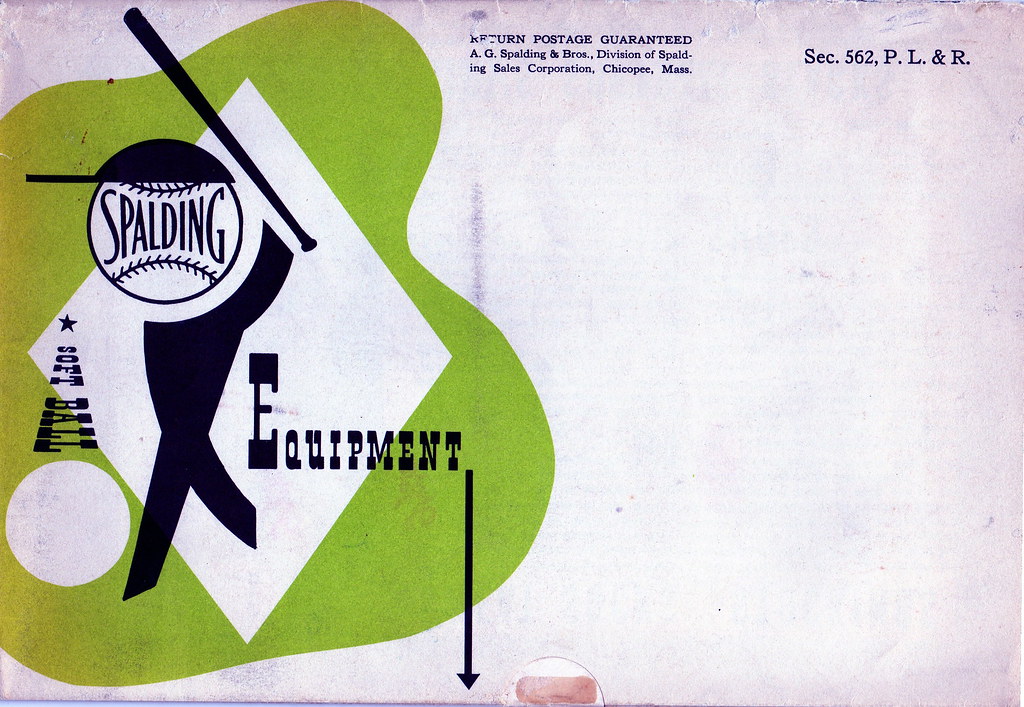
Paul “Uni Watch” Lukas outdoes himself again by posting a bunch of amazing images from his collection of old uniform catalogs. The image at right, picked almost at random from the impressive assortment, is a foldout poster from a 1940 Spalding catalog.
Paul explains that he prefers catalogs from the 1950s or earlier, for these reasons: “(1) Uniform design was more interesting in those days; (2) catalog graphic design was more interesting in those days as well; and (3) the older catalogs are more likely to include fabric swatches, which makes the catalog much more appealing.” Check the rest here.
An item about Hewlett-Packard paying for placement in, of all things, a Jessica Simpson video (oh yeah, that’s cool) mentions that a guy in the video at one point holds some H-P gizmo in such a way that it “flashes H-P’s new hand-shaped logo on the back.” I haven’t seen the video, of course, but this reminded that H-P’s recent print ads have included a hand graphic that looked suspiciously familiar. A moment with Google brought me to this guy, who evidently had the same thought (and this guy, who thought of it earlier). Here’s the side-by-side graphics offered by Guy Number One:

Design Observer has reprinted a piece from The New Republic that I really enjoyed (and would have linked to there, but I think the TNR site puts stuff behind a firewall or whatever). It’s by Rick Perlstein and it’s called “What Is Conservative Culture?”
The interesting thing about it to me is Perlstein’s point that conservative culture hangs together today partly because of a sense of marginality that is basically out of date. In the 1960s, conservative culture had much to do with an underdog/outsider feeling of fighting back against the oppressive liberal machinery, etc. That hardly seems to describe America today.
And yet … conservatives still rely on the cultural tropes of that earlier period: At one living room “Party for the President” in 2004, a woman told me, “We’re losing our rights as Christians. … and being persecuted again.” The culture of conservatives still insists that it is being hemmed in on every side. In Tom DeLay’s valedictory address, as classic an expression of high conservative culture as ever was uttered, he attributed to liberalism “a voracious appetite for growth. In any place or any time on any issue, what does liberalism ever seek, Mr. Speaker? More. … If conservatives don’t stand up to liberalism, no one will.”
I actually think one of the reasons that there are four or five Americas today is that each of the current multiple mainstreams strongly believes it is an oppressed underdog.
Wikipedia is pretty cool, I suppose. I certainly look at it from time to time (though I obviously don’t consider it a definitive final source on anything that I’m writing about). So I was interested in the big New Yorker piece about Wikipedia. It’s good. And it’s been interesting to see how people react to it. For reasons that I don’t fully understand, people get really worked up about Wikipedia — like if you criticize it, you’re an elitist, but if you defend it, you’re a rube. So people tend to quote from the story in ways that back whatever their opinion was before reading the story.
I guess that’s probably why I’m going to quote this line:
Mob rule has not led to chaos. Wikipedia, which began as an experiment in unfettered democracy, has sprouted policies and procedures. At the same time, the site embodies our newly casual relationship to truth. When confronted with evidence of errors or bias, Wikipedians invoke a favorite excuse: look how often the mainstream media, and the traditional encyclopedia, are wrong!
I wish the piece had explored this a little more thoroughly. I think it’s right that there is a “newly casual relationship to truth” about these days — but why? Anyway, I really bring all this up solely as an excuse to link to this Onion story: Wikipedia Celebrates 750 Years of American Independence.
“It would have been a major oversight to ignore this portentous anniversary,” said Wikipedia founder Jimmy Wales, whose site now boasts over 4,300,000 articles in multiple languages, over one-quarter of which are in English, including 11,000 concerning popular toys of the 1980s alone. “At 750 years, the U.S. is by far the world’s oldest surviving democracy, and is certainly deserving of our recognition,” Wales said. “According to our database, that’s 212 years older than the Eiffel Tower, 347 years older than the earliest-known woolly-mammoth fossil, and a full 493 years older than the microwave oven.”
Posted Under:
Pleasing
This post was written by Rob Walker on July 27, 2006
Comments Off on NYer vs. Wikipedia vs. Onion: Onion wins again
 Via Faythe Levine’s blog comes word of YarisWorks, which is “a series of events and celebrations to empower everyday creativity and DIY ingenuity.” While “indie lifestyle community leaders in 12 cities across the country” will be involved, according to a press release reprinted on RedefiningCraft.com, the resulting events “are presented courtesy of Toyota’s stylish, fuel-efficient sub-compact, the new 2007 Yaris.”
The Yaris is a Toyota car aimed at young people, and I’ve actually been wondering about how it will positioned in relation to the Scion, another Toyota car aimed at young people. I guess will Scion is more sort of a DJ/street-art thing, the Yaris is more DIY. “The Yaris is all about celebrating innovation and making design more accessible,” a Toyota marketer says in the press release.
Helping out is DrillTeam Media, “a non-traditional marketing services firm” that helps its clients “access and mobilize independent, influential young tastemakers who are hard to reach and even harder to convince.”
It’ll be interesting to see just how hard it really is to convince the independent young tastemakers to let Toyota “empower” them. Faythe’s take: “This makes me feel a little sick to my stomach knowing that if corporations start doing there own fairs, who will come to us little guys’ shows?” Redefining Craft’s (sarcastic) take: “Party on and let the co-optation begin!”
That sounds like bad news for team Yaris, but we’ll see. According to one article I read last year on the subject of how artists should think about corporate sponsorship, “Selling out is more a matter of circumstance than any absolute rule. Sometimes it can be good.”
Of course, that article was in the Winter/Spring 2005 issue of Scion magazine.
In the latter half of the 1990s, we lived in the West Village in Manhattan. Somewhere during that time I had this idea of starting a Gentrification Walking Tour. It would be just like any of the other many, many walking tours of “historic New York,” but instead of visiting and pointing out the building where Eli Whitney invented the cotton gin (that’s a joke), this tour would visit the various Starbucks and McDonalds and other chain locations of the Village. A very loud tour leader, who I envisioned an overweight man with a beard, a straw hat, shorts, a Hawaiian shirt, and a fanny pack, would barge into these retail spaces and start bellowing to the members of the walking tour about what this or that space used to be, until it was taken over in whatever year by whatever chain occupied the space now.
Consistent with most of my schemes, this one never got farther than me talking about in bars. Toward the end of the 1990s, we moved, and that was that. But I was reminded of all of this over the weekend because I finally got around to listening to the Podcasts at SweatShopper.org, in which artist Kris Hall gives a guided tour of a Wal-Mart in Maine. (I first heard about this on Marketplace, back in April.) Instead of taking off from the shouted-walking-tour idea, her project is more like an iteration of one of those headset narrations you can get at big museums. In this case, rather than hearing biographical anecdotes about Thomas Hart Benton or whatever, you get Hall telling you when to look up and count the security cameras, or making points about the secret labor history of a pair of jeans.
I’m sure some people will find her arguments a bit shrill at times, but I was impressed. Even for a listener who is not literally walking through the Wal-Mart she describes, it has the effect of making you want to look more closely and think harder about retail environments and the abundance within.
There are two recordings here, but they’re close to identical. And for those of you in Skowhegan, Maine, Hall is apparently at the local Wal-Mart, or on a public sidewalk near the store, from 2 to 4 p.m. today, “making the tour available via portable CD player to those folks who do not have ipods. If you are in the area, please come down and be part of the conversation!”
Reebok is a really strange brand. I honestly have no idea what its marketers are trying to do. They’ve associated Reebok with Jay-Z and 50 Cent, with Basquiat, with Nigo (sort of, via that whole Ice Cream thing), and from time to time with athletes.
And now? Scarlett Johansson!
“The actress has joined with the Canton, Mass., athletic giant to design and market an athletic-inspired sportswear and footwear line called “Scarlett [Hearts] Rbk,” says WWD.
Johansson’s line with Reebok will be a lifestyle collection inspired by activewear. Exact looks for the collection have not been made final, but both sides describe the pieces as “fashion forward” as well as retro; retro sneakers and cotton T-shirts will be featured.
“I like to do yoga and stretch out, so we will probably do a bunch of stuff for that,” Johansson told WWD. “Things you can wear to the yoga studio and then to coffee with your friends” — with the emphasis on the coffee part. “I like the idea of exercise and aerobics being glamorous: Olivia Newton John and women exercising in false eyelashes,” she added.
Oh. Okay.
Posted Under:
Uncategorized
This post was written by Rob Walker on July 25, 2006
Comments Off on RBK X S-JO
 So, if you want to, you can pay $50 for a “Targèt Couture Distressed Logo Tee.” This is part of a project involving a boutique called Intuition, in Los Angeles (I’m not familiar with it), selling a new line of Targèt Couture products. Which you can’t, by the by, actually purchase at Target.
“Our own Jaye Hersh collaborated with some of LA’s hottest designers to launch this fun, fashion-forward product line,” the boutique’s website explains. There’s also a $140 pair of jeans, with a Target logo on the ass.
“You won’t find any bargains here,” MSNBC reports. “The high-end clothing, handbags and jewelry range from $25 into the thousands. The new line launched on May 11, and already Intuition has sold more than 3,000 items and is quickly becoming a huge hit among Hollywood’s trendsetters.” Want to see more? Knock yourself out.
In Consumed: gDiapers: An eco-conscious product tries to get beyond eco-conscious consumers.
Jason and Kimberley Graham-Nye could have named their product the Eco-Diaper. After all, one of their chief motivations for selling a “flushable diaper system” is to offer an alternative to disposable diapers, which contribute to landfills and take years to biodegrade. But instead they went with the name gDiapers, which doesn’t mean anything.
Continue reading at the NYT Magazine site via this no-registration-required link.
Related links via del.icio.us.
Posted Under:
Consumed,
Ethics
This post was written by Rob Walker on July 23, 2006
Comments Off on Changing Direction
I don’t know if Dr. Z thought this up, but here’s what the Detroit News (via Autoblog) says Chrysler has planned to sell Jeeps:
Bobble head characters are one way Chrysler Group plans to market its new 2007 Jeep Compass crossover to the targeted age 22 to 30-year-old urban crowd, the automaker announced Friday.
Jeep will introduce the new crossover — a non-traditional Jeep vehicle that shares the same underpinning as Chrysler’s new Dodge Caliber hatchback — through a series of television spots featuring bobble head figures beginning July 31….
The four 30-second commercials will show bobble head characters moving to Hip Hop pioneer KRS-One’s “Steady Bounce” on network, cable and online media. Chrysler chose to go with the bobble head theme because the figurines have a mass appeal to the Jeep Compass target market, the automaker reports.
In one ad, a bobble head drives a Compass through city streets as other bobble heads enviously eye the new wheels. The spot closes with the green bobble heads moving to the music under a mirror ball in the vehicle’s rear as if they were in a dance club…
The automaker will also use product placement in the cable realty show MTV’s “The Real World 18” to market the vehicle.
Jeep will also put the new Compass on display in its month-long Jeep Compass “Uncharted” music tour featuring new artists.
Boy am I looking forward to that! Sounds fresh!



 "
"
 . With









 .
.
 .
.

 Kim Fellner's book
  .
. A
A