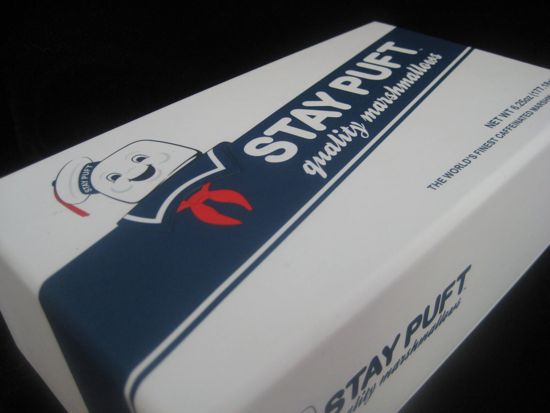
Omni Consumer Products Corporation, leading the way in making imaginary brands into actual buyable products (and written about Consumed a while back) has sent me an advance sample of its next big offering: Stay Puft Quality Marshmallows. They are caffeinated.
Yikes.
Look out for them…
Posted Under:
Imaginary Brands
This post was written by Rob Walker on August 13, 2010
Comments Off on Next up from Omni Consumer Products
[April 28 2010 update: Some better pictures here. Also, PSFK has picked up on this. But if you read Murketing, you got it here first.]
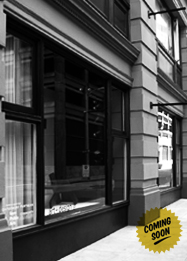
Here’s something pretty cool: Crystal Chou, a graduate student at the Academy of Art University, San Francisco, will tomorrow present her thesis project, Superluxe. This pop-up window installation will be up from April 26 – May 14 at 74 New Montgomery St., San Francisco.
The Superluxe blog explains:
This design project will take form as a window installation of a one stop shop selling do-it-yourself instant lux branding tools. The shop is intended to poke fun at the elitist luxury industry and demonstrate that anyone can create their own luxury empire based on the current industry’s formulaic branding strategies. Through this satiric commentary, the project encourages that the luxury industry move towards a new humble business model of experimentation and creativity.
Needless to say: This is my kinda thing and I wish I could see it in person. Maybe you can? Here are a couple of Superluxe’s “products”:
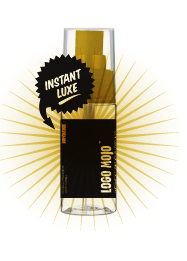 “Logo Mojo and it comes in a form of a spray. It’s a fictitious product that turns a logo into a crazy, fancy, shmancy pattern.”
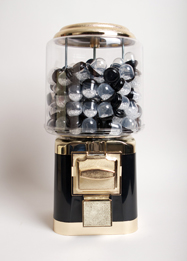
“Bling it up is a typical toy vending machine but dispenses capsules filled with diamonds (plastic diamond confetti).”
Other items on the Merchandise List for Superluxe include: Brand In A Bag; Celebrity Endorsement Certificates; Can of Buzz; etc.
If you get to peek at this, please let me know.
Save
PSFK points out these recent fake products evidently placed in retail locations by TrustoCorp. An example of shopdropping, a form of semiotic disobedience discussed earlier on this site here and here (and also here, when shopdropping was, oddly, picked up as an alleged “trend” by a murketer). Some of these are fun, and an interesting example of using imaginary brands in the real world.
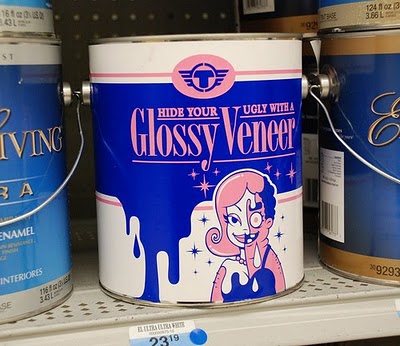
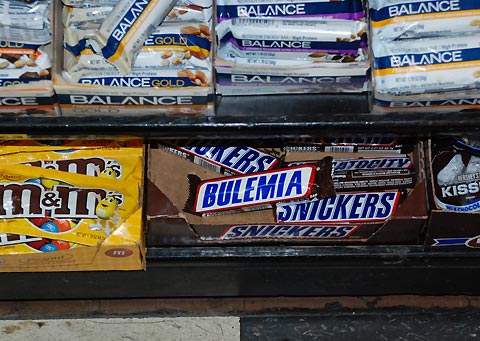
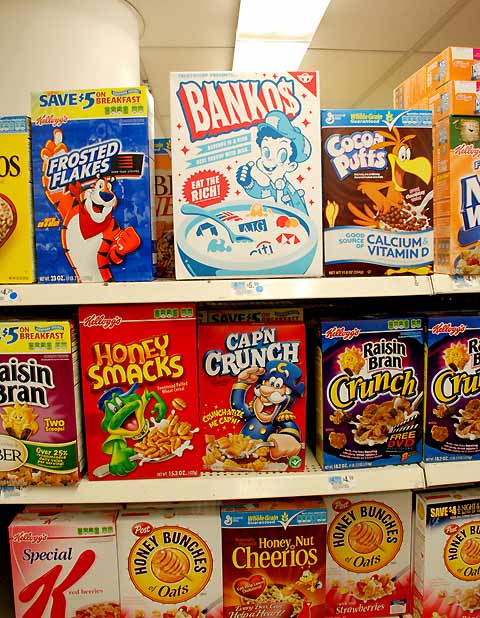
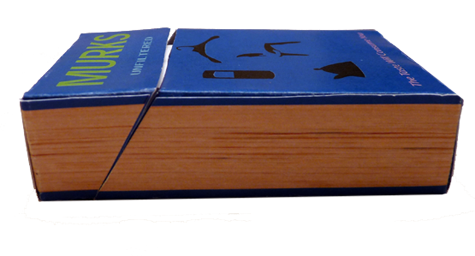
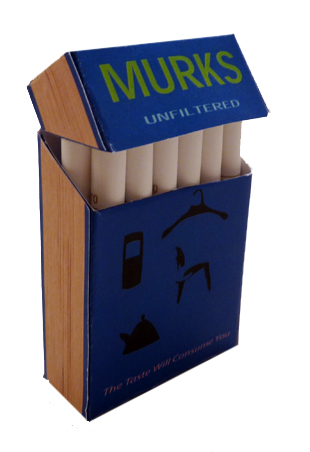
Earlier, the new yet surprisingly comprehensive imaginary-branding-related blog Not A Real Thing made available a template inviting readers to invent their own imaginary cigarette brand. I mentioned it, and to my (happy) surprise, I see that Justin Kirkwood himself has offered up Murks. As he notes, the design is inspired by this site’s rather obsessive cataloging of the idea of the book. (Click either pic for more, and to see his design for a made-up brand of smokes from his spec-screenplay days, Blonde Horses. Nice stuff.)
And yes, that’s right — Murks are unfiltered. The type along the bottom reads: “The Taste Will Consume You.” Yes.
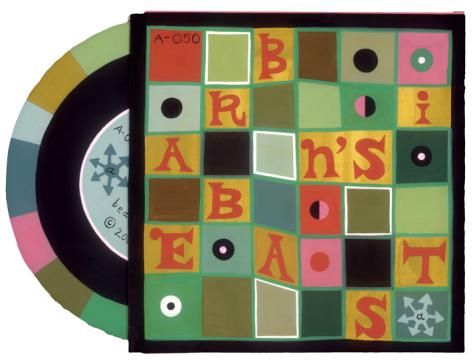
San Francisco singer-songwriter Sonny Smith has a project called 100 Records: He made up 100 fake bands/artists, and wrote songs, created backstories, and so on, for each. An exhibit featuring the covers of the 100 records that resulted is at Gallery 16 in SF. I think this is the related blog. More info here, and here.
Thanks: Steve P.!
Posted Under:
Imaginary Brands,
Music
This post was written by Rob Walker on April 10, 2010
Comments Off on Imaginary bands
I mentioned that I’d have a couple of bits of news from the Significant Objects project that might be of interest to Murketing readers. Here’s one bit.
Today’s story (part of our Paola Antonelli team up, co-published on Core77) is by Matt Brown. I’ve mentioned him a couple of times here in the past; a post on Metafilter described him as a “design fiction enthusiast,” which sounded close enough to my interest in imaginary brands that I was curious. And his work just completely blows me away: He has a peculiar genius for devising alternative histories for random, mass-produced stuff, and expressing this design fiction with both words and, more unusually, completely invented packaging. (In fact he’s now doing a series for Core77, Design Fancy.)
We knew we wanted him involved in Significant Objects. And when Paola Antonelli presented me with her objects, there was one that struck me as being perfect for Brown. This:
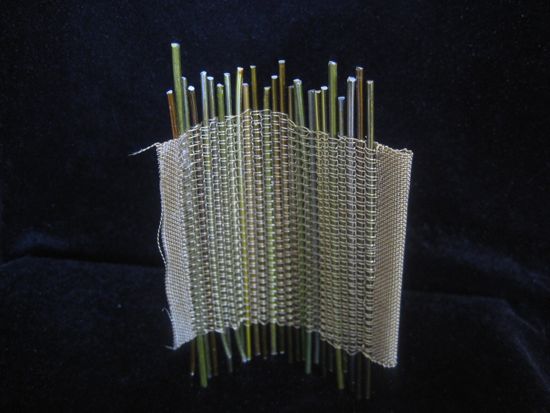
What is it? Well, Anotelli wouldn’t tell me. Turns out Brown, as I suspected, had an answer. It’s a “crumpter.”
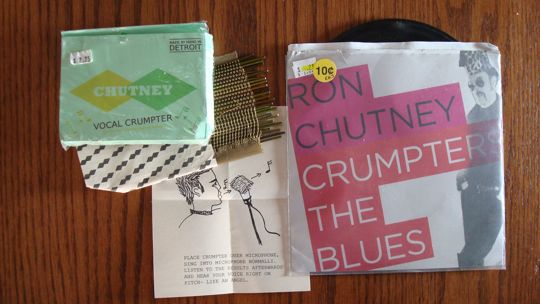
A crumpter, it turns out, is a sort of analog precedent to autotune. Never heard of that? Oh, well then, please read the story over at S.O.
And yes, all the collateral material Brown created is part of the auction.
We’ve sold a mystery object, we’ve sold a story that was itself an object, and now an object whose story is told in part through its packaging.
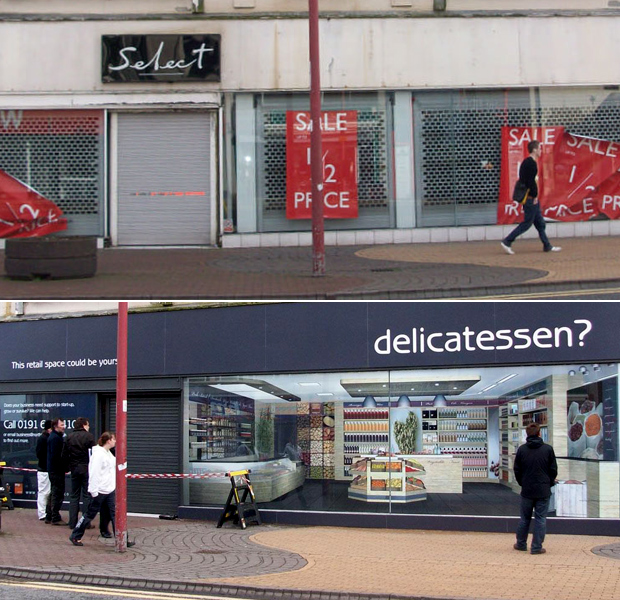
Via PSFK: This brief report on the installation of fake storefronts to make downtown Tynesdale look less moribund than it really is. I’ve been trying to find more/better images, but I’m now giving up. My Google-fu and and Flickr-fu are inadequate, I guess; if you can help let me know.
Meanwhile, here’s my idea for the Tynesdale City Council: Make T-shirts advertising these hypothetical businesses. A nice minimalist slate-gray T with the “delicatessen?” on it could be good.
Also: In my last imaginary brand roundup I forgot to include the below development noted by Gladys Santiago:
If you’ve seen the Filet-O-Fish commercial McDonald’s airs for Lent, then you’re familiar with “Frankie the Fish” and his infectious jingle. Not being one to miss an opportunity to capitalize on kitschy sentimentality, McDonald’s has released a “Frankie the Fish” novelty frame that was obviously inspired by pop culture sensation, Big Mouth Billy Bass.
Here it is:
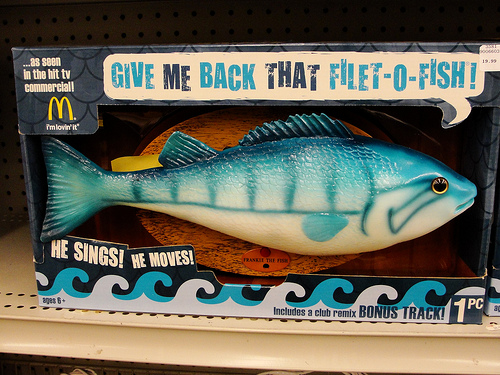
I guess this isn’t “imaginary,” but it’s pretty meta:
Ad campaign “riffs on” (e.g., swipes) a pop-culture-sensation product of the recent past; converts it into a commercial icon; and then takes it to retail, where the packaging continues to deliver the sell (“give me back that filet-o-fish,” which I gather is what the object actually sings) and in fact to tout the item’s tv-ad provenance.
That’s $29.98 at Taylor Gifts.
Posted Under:
Imaginary Brands,
Murketing
This post was written by Rob Walker on March 10, 2010
Comments Off on Imaginary brand variations
Imaginary brands and products are everywhere! People, don’t forget, I’ve been all over this topic for years!
Today’s news:
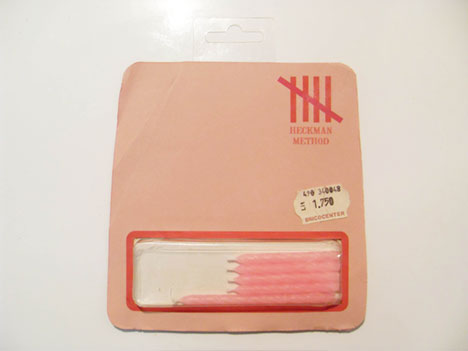
1. Core77 kicks off Design Fancy,”a series of short stories about fictional designers who make fictional things,” here. The entry concerns “the Heckman method” (above), which is explained this way: “This involved selling one long candle for every four short ones. People were warm to the idea initially but abandoned the method once they realized that more wax ended up on the cake this way.”
 2. Elsewhere: SnarkHunting notes that the name of a new Comcast service, Xfinity, interestingly echoes Dunder Mifflin’s internal “infinity” project. Dunder Mifflin is of course the fictional paper company on The Office; its logo includes an infinity symbol.
Xfinity is meant to signal Comcast’s foray into the future of high tech possibilities, while at Dunder Mifflin, “Infinity” is the name of the internal initiative to bring technology to the failing paper company.
Why would the comedy writers of “The Office” chose the name “Dunder Mifflin Infinity” for the high tech effort? Because it is silly, obvious, pitiful and ridiculous, in keeping with ambiance of the show.
Obviously the naming experts at Snark Hunting are being a little, well, snarky, about the wisdom of the Xfinity name’s invocation of infinity-ness. But I think you get the point. If not, here’s how their post ends: “Comcast Xfinity. The possibilities are mindless.”
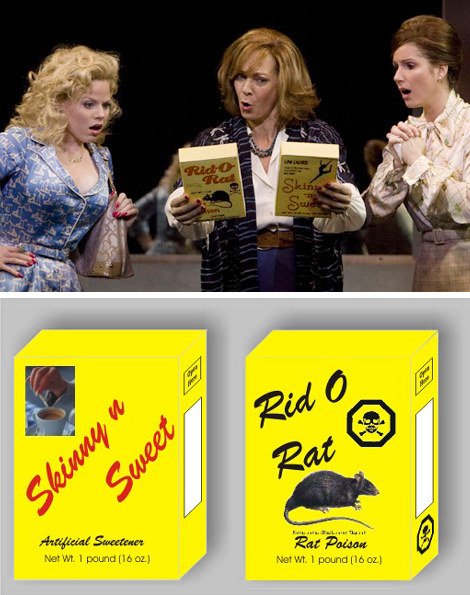
3. And finally: Box Vox zeroes in on two imaginary products — Skinny N Sweet and Rid O Rat — whose similar packaging is a plot point in 9 To 5.
Posted Under:
Imaginary Brands
This post was written by Rob Walker on March 3, 2010
Comments Off on More more more imaginary brand stuff
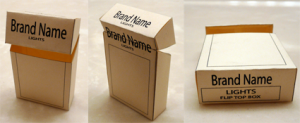
Imaginary branding is one of my favorite topics, and I’m not alone: In addition to Gladys Santiago’s impressive Product Displacement Tumblr, there’s a new arrival on the brands/fiction scene: Not A Real Thing, a blog by Justin Kirkwood.
In addition to compiling a good master list of imaginary brands, Kirkwood is doing some real work here, not just pointing out fictional brands like Red Apple Cigarettes but telling us who created them (in this case, “longtime Tarantino friend, art department employee, and former video rental store colleague Jerry Martinez”). And as a bonus, for that entry he’s created a downloadable template for you to create your own cigarette brand-design.
Would a Murketing cigarette pack be cool? Design one and send it to Kirkwood! And keep an eye on his site.
[This is a slightly tweaked cross-post from SignificantObjects.com.]
Here’s yet another twist on adding an invented narrative to a seemingly low-value thingamabob:
Designer Matt Brown bought a pack of 15 plastic horses for a couple of bucks. Then he dreamed up a name for each one, then packaging, reconceptualizing his two-dollar purchase as a line of toys, Night Horses, that were introduced in the late 1980s, and flopped.
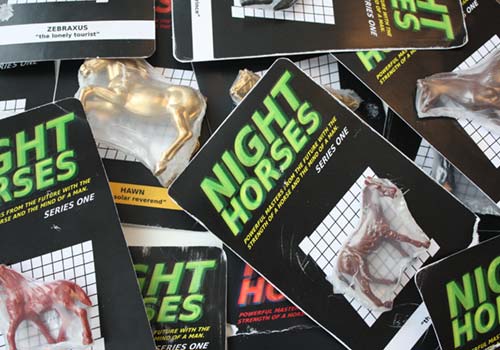
Hey, remember Night Horses? (No, you don't.)
I love it!
More recently Brown has embarked on another project, turning some toy cars into another failed product line. They’ll be retroactively rebranded as Throttle Dukes. More here.
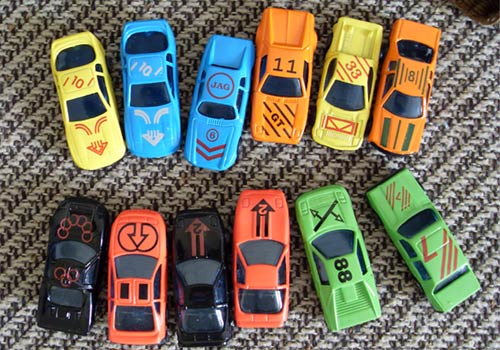
Throttle Dukes, to be.
Is this more evidence of the “significant objects meme” that my Significant Objects colleague Joshua Glenn has detected? I don’t know.
“I like taking things that are basically worthless and neglected and turning them into something that people could enjoy again,” Brown writes. Combine that with my longstanding interest in imaginary brands, and you can see why I’m so into it.
(Via Metafilter, where Brown was referred to as a “design fiction enthusiast.”)
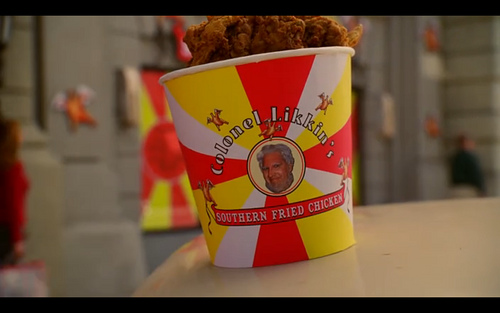
As some of you know, I have (https://comfortdentalcareofbrookline.com/order-zithromax-500mg-online/) a particular fascination with imaginary brands — it’s a subject that’s come up in Consumed (here and here), and on this site, and in my Delicious links. So I was extremely interested to learn of this Tumblr blog, curated by Gladys Santiago, documenting what she calls “product displacement.”
This involves the use of imaginary brands as, in effect, stand-ins for real brands we already know. For instance, above, a bucket of Colonel Likkin’s Southern Fried Chicken. I don’t have to tell you what that stands in for. Apparently it was used on the TV show Pushing Daisies. Other examples: Coffee Bucks on Scrubs, and TitTat candy on My Name Is Earl. (The Product Displacement blog also documents instances of unbranding — as when the logos are removed from cars and so on — but I’m not going to address that here.)
Santiago (who I got to meet, briefly, the other night at the Blowing Up The Brand event) explains the parameters of product displacement here. And here she argues that some product displacements are “arguably more clever and memorable than even some of the most exhaustedly planned brand integration strategies. ”
It requires no stretch of the imagination to recognize “Tit Tat” and “Coffee Bucks” as stand-ins for real brands, but that recognition allows audiences to engage with product placements in a manner that is significantly more encompassing than simply spotting a branded product onscreen. Referencing these product displacements to their real world counterparts requires audiences to actively draw upon their cultural capital and awareness, therefore they have more resonance than a strategically placed can of Coca-Cola or character mindlessly raving about his/her T-Mobile phone.
Ultimately, product displacements have the opportunity to flatter the intelligence of viewers, especially if they are parodic and satirical in nature. I particularly like My Name is Earl and Scrubs examples because they provide an allure of audience members being in on a private joke that mocks Kit Kat and Starbucks.
Pretty interesting!
Oh, and Santiago has also created this massive Flickr set of “deliberate and unintentional” examples of product appearances in scripted shows.
UPDATE: Follow-up posts worth a look on Eyecube, and AdFreak.
Posted Under:
Entertainment,
Imaginary Brands
This post was written by Rob Walker on May 12, 2009
Comments Off on Imaginary brands as “product displacement”
 There were reports a while back that the imaginary brand Booty Sweat, a prop (so I read) in the Ben Stiller movie Tropic Thunder, would be released as a real product — like Brawndo (May 4, 2008 Consumed subject) — and supposedly in two different packages, one for the “urban” market, one for the “rural” market. (I don’t know about suburbs, exurbs, etc.)
I’ve now seen a few things suggesting it’s actually in stores, at least in some places. It’s made by Boston America, a novelty-manufacturer that does a lot of licensed goods, and it sounds to me more like a straight-up promotional proposition (given away at screenings). But it does seem to exist, for now at least. If you have encountered it and have thoughts, let me know.
Here is the loud and annoying Web site for the drink, where you are invited to bother your friends by telling them about Booty Sweat.
[For a roundup of other, non-imaginary brands appearing in Tropic Thunder, see Brand Channel’s Brand Cameo, which notes: “TiVo and Diet Coke are the true brandcameo stars of this movie that mocks not just movie stars, but every aspect of the film industry—even product placements.”]
 Here at Murketing HQ, we’re particularly fond of one of the newer offerings from Last Exit To Nowhere (a November 17, 2007, Consumed subject).
This time around the imaginary brand is Genco Pura, “the finest Sicilian olive oil.” As you may know, this is a business formed by Mr. Vito Corleone — although it turned out that he had an number of, you know, other interests.
There’s a “continental ladies fitted” version as well.
How can you refuse?
 I haven’t seen Wall-E, but yesterday someone* was telling me about it. I wasn’t taking notes but Wikipedia says much what she was saying about the movie’s plot. (Spoiler alert!) Here’s the context:
In the 22nd century, the megacorporation Buy n Large assumed every economic service on Earth, including the government. Overrun by un-recycled waste, the planet eventually became so polluted that it could no longer support life. In an attempt to keep humanity alive, Buy n Large sponsored a five-year exodus to outer space aboard massive executive starliners…
Etc. Etc. So Wall-E, who I guess is technically a Buy n Large product, eventually saves the day, or whatever.
Anyway, details aside, the point seems to be that a rampant corporation took over the world and didn’t give a rat’s ass about the ecology, and so on: Profit motive runs amok.
So it’s interesting to read that according to Ad Age, this article deconstructing the product-placement style used in the film. Read more
 I’ve linked to past entries in the Brand Autopsy series “Would you miss …?”
But this is the best one: Would you miss Dunder Mifflin? That’s the non-existent paper company in The Office.
Side note: Look at all this Dunder Mifflin merch!


 "
"
 . With





 .
.
 .
.

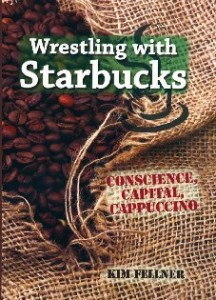 Kim Fellner's book
  .
. A
A